LED Light Box Advertising: ROI Analysis and Performance Metrics for Business Owners

You want to see if LED Light Box Advertising gives good ROI for your business. Many business owners get great results. ROI for LED signs is usually between 15% and 150%. Tracking ROI and performance metrics helps you make smart choices before spending money. LED signage costs less than old advertising and gives better recall and more people see it. The table below shows how LED billboards do compared to other ads:
Advertising Type | Exposure | ROI Comparison |
|---|---|---|
LED Billboards | Highest exposure | |
Newspaper, TV, Radio | Lower exposure | Lower ROI |
You can use simple steps and clear plans to get the best results.
Key Takeaways
LED light box advertising can bring in more customers. It can increase visits by up to 60%. This makes it a strong way to help sales grow.
It is important to measure ROI. You should check how many people see your sign. Also, look at how many people interact with it. Track how many people buy after seeing the sign. This helps you know if your sign works well.
Put your LED signs where many people walk or drive by. This helps more people see your message. It can bring in more possible customers.
Keep your sign clean and working well. This keeps it bright and easy to see. A good sign helps people stay interested in your business. It also helps your brand look good.
Use data analytics to make your ads better. Try out different designs and messages. See which ones get the best results.
Does LED Light Box Advertising Deliver ROI?
ROI Expectations for Business Owners
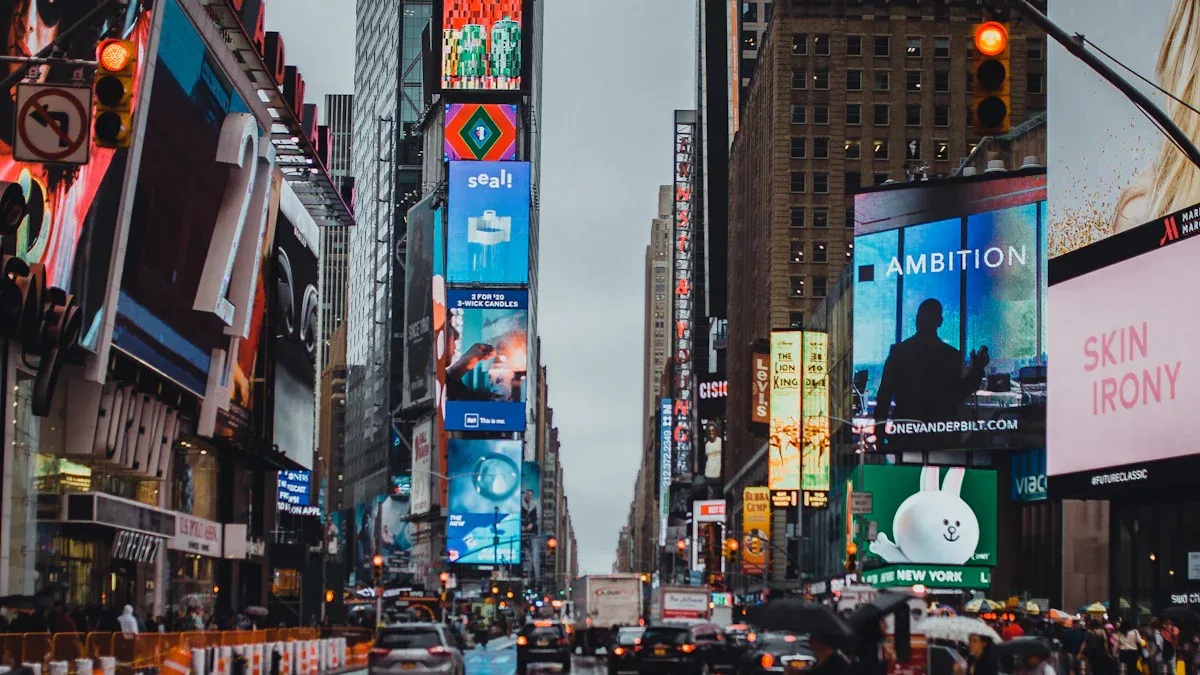
You want to find out if led light box advertising gives you good value. Many business owners get great results from it. If you buy a led sign, you will likely get more customers and sell more products. Outdoor lighted sign boxes can help bring in 60% more visitors. Businesses using digital signage roi methods can get up to 32% more return than old ads. It costs about $0.15 to show your sign to a thousand people, so it is a cheap way to advertise.
Here is a simple table that shows usual ROI numbers for small and medium businesses:
Item | Amount ($) |
|---|---|
Total Investment Costs | 25,000 |
Extra Revenue in One Year | 40,000 |
ROI (%) | 60% |
You can see that checking signage roi helps you know how much you gain from your spending. If you want your business to grow, led light box advertising is a good way to get better results.
Real-World Effectiveness
Real businesses have gotten strong results with led light box advertising. You can look at these examples to see how digital signage roi works in real life:
Investment | Payback Period | Sales Increase | Customer Engagement | |
|---|---|---|---|---|
New York Independent Bookstore | $556 | 7 weeks | +18% | +22% dwell time |
Chicago Fitness Studio | $750 | 10 weeks | +12% membership | +35% social posts |
San Francisco Convenience Store | $350 | < 3 months | +19% evening sales | +17% dwell time |
You can see that each business got more sales and more people interested after they put up a led sign. These facts show that led light box advertising can give you real roi. When you keep track of signage roi, you make better choices and help your business grow.
Defining ROI in LED Light Box Advertising
What ROI Means for LED Signage
You want to know what roi means when you invest in a led sign for your business. ROI stands for "return on investment." It shows how much money you make compared to what you spend. You can use clear steps to measure roi for signage. Here is a simple way to define it:
Set clear goals for your sign, like more sales or more visitors.
Count how many people come into your store before and after you install the sign.
Compare your sales numbers from before and after you put up the sign.
Add up all the costs for your signage, including buying, installing, and running it.
Ask customers if they notice your brand more, using surveys or online tools.
Find out how much each new customer is worth over time.
Electronic message centers are not only the top-tier method of paid advertising, but also the most cost-efficient. They stand as the most effective and least expensive form of advertisement, boasting an expected return of 15% to 150%.
A study from the Small Business Administration found that businesses using electronic message centers can see revenue grow from 15% up to 150%. This shows that led signage can give you strong results when you track your roi.
Why ROI Measurement Matters
You need to measure roi for your led light box advertising. This helps you see if your campaign makes money. You can track important numbers like how much you spend and how many new customers you get. Here are some reasons why roi measurement matters:
You find out if your advertising is profitable.
You can track numbers like Return on Ad Spend and Customer Acquisition Cost.
You use data to decide how much money to spend on advertising.
You can make your campaigns better by seeing what works.
When you measure roi, you make smart choices for your business. You can see the real value of your signage and improve your results over time.
Key Metrics for Measuring Signage ROI
If you want to know if your led sign is worth it, you should look at important numbers. These numbers show how well your sign works and what it does for your business. You can use these numbers to check how many people see your sign, how they interact with it, how many buy something, and if you are spending money wisely. When you measure signage roi, you make smarter choices and get better results.
Visibility and Reach Metrics
Visibility means how many people notice your sign. Reach is about how far your message goes. You can keep track of these numbers to see if people pay attention to your sign. Here are some ways to do this:
Count how many people walk by your sign every day.
Use cameras or sensors to see how many people are near your sign.
Ask customers if they saw your sign before coming inside.
Check if more people know your brand after you put up the sign.
Tip: If lots of people see your sign, more people will know about your business. This can bring in more visitors and help you sell more.
You can use information from sensors or surveys to find out if your sign reaches the right people. When you check visibility, you learn if your sign helps more people notice your business.
Engagement and Conversion KPIs
Engagement is how people react to your sign. Conversion means turning people who see your sign into buyers. You need to watch these numbers to see if your sign helps your business grow. Digital signage usually gets more attention and sales than print ads.
Here is a table that shows how digital signage and print ads compare:
KPI Type | Digital Signage | Print Advertising |
|---|---|---|
Engagement Rate | Higher because people can interact | Lower, uses less direct ways |
Conversion Rate | More exact with live data | Less exact, uses indirect ways |
Goes up by 47.7% | Hard to measure the same way | |
Customer Footfall | Goes up by 23% | Not used |
Sales Boost | Up to 25% more sales | Not used |
Digital signage can help more people know your brand and get interested. It can bring in 23% more visitors. Sales can go up by 25%. Things like touchscreens and QR codes let you talk to customers and see results right away.
Note: When you check engagement and conversion, you find out which messages work best. You can change your sign to get even better results.
Cost Efficiency Analysis
Cost efficiency means getting the most for your money. You want your sign to make more money than it costs. You can use easy math to check cost efficiency:
Add up all the costs for your sign, like buying, setting up, and fixing it.
Keep track of the extra money your sign brings in.
Divide the extra money by what you spent to find your roi.
You can also use different models to see which steps help people buy. Here is a table that explains these models:
Model Type | Description | Pros | Cons |
|---|---|---|---|
Single-touch | Looks at one step (first or last) | Good for seeing first steps | Misses other steps in the journey |
Multi-touch | Checks many steps along the way | Shows all the steps | Harder to use |
W-shaped | Splits credit between first, middle, and last steps | Fair, looks at all steps | Picking steps can be tricky |
Linear | Gives equal credit to each step | Counts every step | Doesn't show which step matters most |
U-shaped | 40% credit to first and last, 20% to others | Shows some steps matter more | Misses steps between first and last |
Time decay | More credit to steps close to buying | Shows what leads to buying | Doesn't count early steps as much |
Full path | Like W-shaped but with more details | Shows the whole journey | May not work for quick buys |
Custom | Made for your business goals | Gives special credit to steps | Can be hard and expensive |
Pick a model that works for your business. Multi-touch and W-shaped models help you see how your sign affects customers. When you use these models, you can prove your sign is worth it and make better choices.
Block Quote: Watching key numbers and picking the right model helps you see how your sign really works. You can change your plan and get the most roi.
When you measure signage roi with visibility, engagement, conversion, and cost efficiency, you get the facts you need. You see what works, make things better, and help your business grow with led signage.
Calculating Digital Signage ROI
ROI Calculation Steps
You can measure the return on your digital signage by following a clear process. This helps you see if your lighted sign brings real value to your business. Here are the steps you should take:
Calculate Total Initial Costs
Add up everything you spend to buy and install your LED sign. This includes the price of the sign, installation fees, and any setup costs.Estimate Energy Savings Over Time
LED signs use less power than older lights. Figure out how much money you save on energy bills each year.Factor in Reduced Maintenance Costs
LED signs last longer and need fewer repairs. Write down how much you save by not having to fix or replace parts as often.Incorporate Incentives or Rebates
Some cities or states offer rebates for using energy-saving products. Check if you get any money back for choosing LED.Use a Simple ROI Formula
Once you have all your numbers, you can calculate your ROI. This shows how much you gain compared to what you spend.
Tip: Tracking these steps helps you see the real impact of your investment. You can use this data to make better choices for future advertising.
ROI Formulas and Examples
You can use a simple formula to find your ROI:
ROI (%) = [(Total Gains from Investment - Total Costs of Investment) / Total Costs of Investment] x 100
For example, if your new sign brings in $40,000 in extra sales and costs $25,000 to buy and install, your ROI would be:
ROI (%) = [($40,000 - $25,000) / $25,000] x 100 = 60%
You can see how this works in real businesses. The table below shows how different retailers measured their ROI and payback periods after adding digital signage:
Retailer / Example | ROI / Payback Period | Key Benefits and Outcomes |
|---|---|---|
Maurer’s Market | 1.5 to 2.5 years | Price updates now take 10 minutes instead of 4 days; 80% less labor time; fewer mistakes |
Houchens Food Group | ~3.5 years | Labor and cost savings across many stores |
TRUNO (30,000-tag system) | 2 to 3 years (1 year w/AI) | Large system; $350,000 investment; faster payback with AI pricing |
Electronics Retailers | Within 1 year | Fast price updates; dynamic pricing; better revenue and efficiency |
Small Retail Stores | 1 to 3 years | Labor savings; no printing costs; 30% fewer pricing errors; better pricing accuracy |
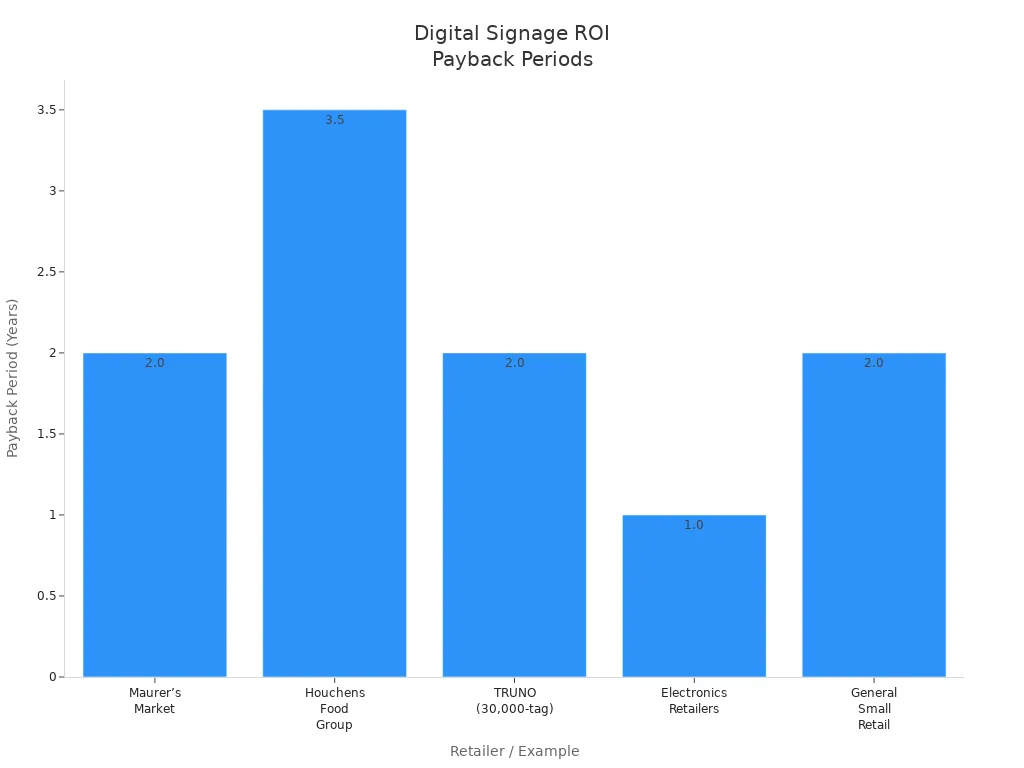
You can see that many stores get their money back in one to three years. Some stores see a sales uplift right away. For example, one business saw closing ratios jump from 18% to 24% in just four weeks. Their profit per sale grew by $420. The system paid for itself in less than a month. Over a year, their ROI reached 314%.
You can also use ROI analysis tools for electronic message centers. These tools help you track how many new customers come in after you install your sign. A survey of 12,000 businesses found that 46% of first-time customers came in because they saw an electronic message center. Some businesses reported revenue increases from 15% up to 150%. One store making $1,000 a day saw a 15% revenue boost after adding a sign, which meant $46,800 more each year. The cost per thousand views for these signs is very low, often less than $0.37.
Note: When you use these tools and formulas, you get a clear picture of your conversions and sales uplift. You can see how your investment pays off and make smart decisions for your business.
Factors Impacting LED ROI
Placement and Location
Picking the best spot for your LED sign helps a lot. Busy places let more people see your message. You should choose spots where many people walk by. Some good places are:
Airports
Train stations
Bus stops
Busy sidewalks
Shopping centers
Popular tourist attractions
Putting your sign in these places means more people notice it. This helps more people pay attention and gives you better roi.
Design and Customization
How your sign looks is very important. Good visual marketing can make people pay more attention. It can boost engagement by up to 94%. You want your sign to stand out and be easy to see. Advanced LED integration makes your sign bright and saves energy. SEG technology keeps your graphics sharp and neat.
You can make your sign special by using:
Custom sizes and shapes
Features like interactive screens
These choices help your sign match your brand and bring in more customers.
Maintenance and Upkeep
Taking care of your sign keeps it working well. Digital signs need cleaning, hardware checks, software updates, and system checks. Static signs only need simple cleaning and small fixes. Here is a table that shows how maintenance changes your results:
Signage Type | Impact on ROI | |
|---|---|---|
Digital | Regular cleaning, hardware checks, software updates | Higher engagement but higher maintenance costs |
Static | Low maintenance, mainly cleaning and minor repairs | Lower overall costs but potentially less engagement |
You should watch maintenance numbers and use them to plan care. This helps you stop problems and keeps your sign working well.
Audience Targeting
You get better results when you show your sign to the right people. LED displays with clear graphics and bright lights make your store or booth look great. These things bring in more people and help them pay attention. Good visual marketing can boost engagement by up to 94%. You should make your sign stand out for the people you want to reach.
Tip: When your message fits your audience, your advertising works better and you get more roi.
Tools for Measuring Signage ROI
Manual Tracking Methods
You can measure the roi of your led sign with simple tools. These methods help you see how your sign changes your business. You might use infrared sensors to count people coming in. Video analytics can show how long people look at your sign. They also show who is looking. You can connect your checkout system to see if sales go up when you change your sign. Mobile tracking lets you see how many people scan QR codes on your sign.
Metrics Measured | Implementation | |
|---|---|---|
Infrared Sensors | Foot traffic count | Entry points |
Video Analytics | Dwell time, demographics | At sign locations |
POS Integration | Sales correlation | Checkout areas |
Mobile Tracking | Digital engagement | QR code scans |
You can also ask customers questions after they see your sign. You can talk to them or check online reviews. Watching social media and asking workers what they notice helps too.
Digital Analytics Platforms
Digital analytics platforms help you learn more about your sign. These tools collect lots of data from different places. They show you how your digital signage works over time. You can track how many people see your sign. You can see how they interact and if they buy something. Analytics platforms help you find patterns and make changes to get better results. You can set up dashboards to watch important numbers like engagement and sales.
Tip: Use analytics platforms to test different designs and messages. Try a new design for 4-6 weeks. Change your message for 2-3 weeks. Switch your call-to-action for 3-4 weeks. Watch how these changes affect your results.
Integrating Data Sources
You get the best results when you mix data from different places. You can link foot traffic counts, sales numbers, and engagement data. This helps you see which parts of your sign work best. You can change your plan based on what you learn.
Mixing different data sources helps you understand how your sign works. It helps you see which signs bring in sales. This way, you can keep making your signs better by using what the data shows.
When you use manual tracking, analytics platforms, and mixed data, you make smarter choices. You can improve your digital signage and help your business grow.
Common Pitfalls in LED Light Box Advertising
When you use LED light box advertising, you want good results. Some mistakes can make your sign less helpful. If you know about these problems, you can fix them. This helps you get more from your sign and improve your roi.
Overlooking Key Metrics
If you do not watch the right numbers, you will not know if your sign works. Many business owners forget to check things like visibility, engagement, conversion, and cost efficiency. If you miss these numbers, you might spend money and not know if your led display brings new customers or sales.
Metric | Impact on ROI |
|---|---|
Visibility | Lets more people see your business |
Engagement | Shows if people notice your message |
Conversion | Tells you if people buy after seeing your sign |
Cost Efficiency | Checks if your spending is worth it |
Tip: Always use a way to track your results. You can use QR codes or special deals. This helps you know which ads work best.
Poor Placement Choices
If you put your sign in the wrong place, you waste money. A spot with few people or bad views means fewer people see your message. This means your ad does not reach many people and your campaign may not work.
Consequence | Description |
|---|---|
Not many people see your ad | |
Wasted impressions | You spend money but get little back |
Low recall | People do not remember your message |
Unsuccessful campaign | Your goals are not reached |
Picking a cheap spot that is not busy often gives bad results.
Places with lots of people help your sign do better.
Neglecting Maintenance
If you do not care for your sign, it might break or show old messages. Problems like blank screens or old content can upset customers and hurt your brand. A sign that is not cared for can make your business look bad.
Dust, sun, and weather can harm your led sign if you do not check it.
Bright screens and good airflow help your sign last longer.
Cleaning and updates keep your message new and interesting.
Note: Plan to take care of your sign from the start. A clean and working sign keeps bringing in customers and protects your money.
Maximizing ROI with LED Signage
Optimizing Design and Messaging
You can get better results by making your sign look good. Visual marketing helps more people pay attention. It can make engagement go up by 94%. Edge-to-edge printing makes your sign look neat and clear. Using the right colors helps people see your message. Your sign stands out, even in busy places. High-resolution graphics make your business look professional. They also help your sign get noticed. If you add movement, people look at your display faster. Keep your message short and simple. This helps people understand it quickly. Use bright colors and big, easy fonts. This makes your sign easy to remember.
Tip: Try different designs and messages. Collect data to see which ones get the most attention. Change your sign to use what works best.
Strategic Placement
Where you put your sign is important. You want lots of people to see it. Put your LED sign in busy places. This helps more people notice your business. For example, a gas station used outdoor LED signs. They got three times more money back in a few months. They used a 4x8 pole sign and window signs. The business saw more people come in. Fuel sales went up. More people bought things inside the store. The cost for a custom sign is about $3.70 each day. The CPM is less than $0.37. This is much cheaper than TV ads. TV ads have a CPM of about $5. On-premise signage works best for small businesses. It also costs the least.
You should watch where people walk and gather. Put your sign in those spots. This helps you get better results from your sign.
Regular Performance Reviews
You need to check your numbers often. Track how many people see your sign. Watch how they interact with it. Look at sales before and after you put up your sign. Use data to find the best designs and places. Check your results every month. Make changes if fewer people pay attention or buy things. Regular checks help you keep your ROI high. They also keep your advertising fresh.
Review Step | What to Check | How Often |
|---|---|---|
Visibility | Foot traffic, views | Weekly |
Engagement | Interactions, dwell time | Monthly |
Sales Results | Revenue changes | Monthly |
Data Analysis | Compare metrics | Quarterly |
Note: When you check your results, you make smarter choices. You can keep making your sign better.
You can help your business grow by checking and improving roi with led light box advertising. Look at the table below to remember important steps:
Key Takeaway | Description |
|---|---|
Visibility | Outdoor lighted sign boxes can bring in 60% more customers. |
Strategic Placement | Put your sign where drivers and people walking can see it easily. |
Maintenance | Clean and check your sign often so it stays bright and works well. |
Compliance | Follow local rules so you do not get fined. |
Watch the right numbers and use facts to make choices, like testing with different groups and changing things quickly. If you need more help, check out resources from REACH Media Network and Teksetra.
FAQ
How long does it take to see ROI from an LED light box?
You can often see ROI within 1 to 3 years. Some businesses notice results in just a few months. Your payback period depends on your location, sign design, and how many people see your sign.
What is the average cost of an LED light box?
Most LED light boxes cost between $500 and $5,000. The price depends on size, features, and installation needs. You should ask for quotes from several vendors to compare options.
Can I measure how many people see my LED sign?
Yes. You can use foot traffic counters, video analytics, or customer surveys. These tools help you track how many people notice your sign each day.
Do LED signs work better than traditional signs?
LED signs usually get more attention. They are brighter and can show moving messages. Studies show LED signs can bring in up to 60% more customers than static signs.
What maintenance do LED light boxes need?
You should clean your sign regularly and check for any damage. Update your messages often. Most LED signs need less maintenance than older signs, but you should still plan for basic care.
See Also
Essential Guide to LED Sign Boxes for Business Owners
Understanding Digital Signage ROI and Its Business Benefits
Enhancing Visibility with Rotating LED Signs: Key Insights
