How to Choose LED Strip Lights for Your Light Box

When you choose led strip lights for your light box, you make a big difference in how your project looks. The right LED strip gives you smooth, even lighting. If you pick the wrong one, you may see these problems:
Hotspots appear when strips are too close or uneven.
You may pick the wrong color if you do not think about what you need.
Short strips can make your light too dim.
Low LED density lowers light quality.
Key Takeaways
Pick the best LED strip density for smooth lighting. Strips with more LEDs give softer light and fewer bright spots.
Think about how thick your light box is. A box that is deeper spreads light more and cuts down on shadows.
Choose the right color temperature for your project. RGBCCT strips let you change color and brightness easily.
Choose LED Strip Lights for Your Light Box
Types and Density of LED Strip Lights
When you choose led strip lights for your light box, you need to know the main led strip light types and their densities. The density tells you how many LEDs are on each meter of the strip. This affects how smooth and bright your light looks. If you want even lighting, you must pay attention to the types of led strips and their density.
Here is a table to help you compare the most common densities:
Density Type | LEDs per Meter | Application |
|---|---|---|
Standard Density | 30 LEDs/M | Indirect, accent lighting, and tight spaces |
High Density | 60 LEDs/M | Brighter applications needing more illumination |
Premium Density | Up to 512 LEDs/M | High-profile projects with seamless light output |
You can also look at how density changes the performance:
Standard Density (30 LEDs/M) works well for accent lighting. You can use longer strips, up to 32 feet.
High Density (60 LEDs/M) gives you more brightness but you can only use up to 16.4 feet in one run.
Premium Density (up to 512 LEDs/M) creates a seamless look. This is best for reflective surfaces or when you want no visible dots.
LED density affects how even your light looks. If you use a low-density strip, you may see bright spots or shadows. High-density strips give you smoother light. The way you install the led strip lights and the beam angle also change the final effect. You should always match the density to your project needs.
Light Box Thickness and Strip Positioning
The thickness of your light box changes how you choose led strip lights. A thicker box, at least 3 inches deep, helps spread the light better. If your box is too thin, you may see hotspots or uneven lighting.
You should place the led strip lights with enough space from the walls. This helps avoid harsh shadows and bright spots. Try to keep at least one inch between the strips and the back wall. This space lets the light spread out and mix before it hits the front of the box. Good airflow around the strips also helps prevent heat buildup, which can damage the LEDs.
Tip: Always measure your light box before you install the led strip lights. Plan where you will put each strip to get the most even light.
Color Temperature and RGBCCT Options
When you choose led strip lights, you must think about color. The color temperature tells you if the light looks warm (yellow), cool (blue), or neutral (white). Some projects need a fixed color, but others need more options.
If you want to change the color or adjust the white light, look for RGBCCT led strip lights. These strips combine RGB, CCT, and warm white LEDs. You can pick from many led strip colors and adjust the white light to match your needs. RGBCCT strips work well for displays, art boxes, or any project where you want to control the color and brightness.
You can use a remote or smart controller to change the color and brightness. This gives you full control over your light box. RGBCCT strips are the most advanced type of led strip lights for projects that need flexible lighting.
Note: If you need only one color, you can use single-color led strip lights. For more control, choose RGBCCT.
Buying LED Strip Lights: Key Factors
Brightness and Power Consumption
When you buy led strip lights, check how bright they are and how much power they use. Brightness means how much light the led strip lights give. For most light boxes, you need strips with 675 to 690 lumens for each foot. This amount of brightness stops dark spots and keeps your display easy to see.
Lumen Output (lumens/foot) |
|---|
675 - 690 |
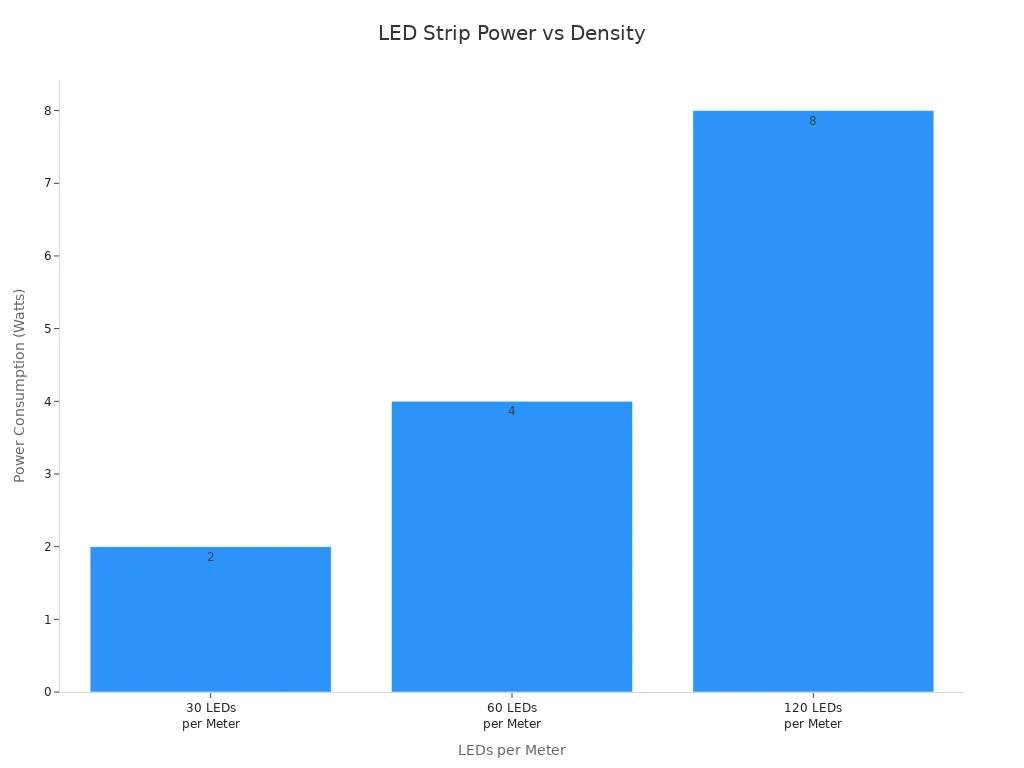
Power use changes if you pick strips with more leds or more brightness. Strips with more leds use more power. You can see this in the table below:
Length (meters) | LEDs per Meter | Average Power Consumption (Watts) |
|---|---|---|
1 | 30 | 2 |
1 | 60 | 4 |
1 | 120 | 8 |
LED strip lights use less energy than old bulbs. This saves you money and helps the planet.
Quality and Durability
When you buy led strips, you want them to last a long time and be safe. Look for certifications like UL Listed, ETL, and FCC. These show the led strip lights are safe to use. Good led strips can last from 50,000 to 100,000 hours. Some brands give you a warranty for up to 15 years. Humidity and heat can change how led strips work, so pick waterproof ones if you need them.
Certification | Importance |
|---|---|
UL Listed Certification | Ensures safety standards and rigorous testing for LED products. |
ETL Certification | Recognized symbol of product safety and compliance in North America. |
FCC Compliance | Guarantees products meet electromagnetic interference requirements. |
Tip: Always look at the warranty before you buy led strip lights.
Project Requirements and Customization
You need to pick led strip lights that fit your project. Think about voltage, if you need waterproofing, and what colors you want. Custom-cut led strips are easy to install and let you change the beam angle for better light. Use diffusers to make the light even. If your box is in a wet place, get waterproof led strip lights.
Factor | Description |
|---|---|
Voltage Selection | Choose voltage based on project length: 5V for under 2m, 12V for under 5m, 24V for under 10m. |
Waterproofing | Select waterproof rating based on location; options available for different environments. |
Lumen Management | Higher LED density results in increased brightness; choose the densest configuration for strict requirements. |
Light Quality | Ensure even light distribution to maintain effectiveness and comfort; consider diffusers and profiles. |
Note: Customizing your led strip lights helps you get the best brightness and color for your light box.
Installation of LED Strip Lights in Light Boxes
Measuring, Cutting, and Mounting
You need to measure and cut your led strip lights carefully for a smooth installation. Follow these steps for the best results:
Measure the length you need for your light box.
Find the dotted cut line between the copper dots on the led strip.
Cut along the line with scissors to avoid damaging the circuit.
For mounting, use these tips to keep your led strips secure and even:
In small light boxes, place the led tape around the edge, shining inward.
In larger boxes, mount the strips on the inside back, facing the acrylic front.
Space the strips based on the box depth. A good rule is to keep the distance between strips about 25% less than the space from the back to the front panel.
Tip: Always plan your installation before you start cutting or sticking the led strips.
Avoiding Hotspots and Electrical Issues
Hotspots can ruin the look of your light box. They often happen because of poor heat control, bad installation, or electrical problems. Make sure your box has good airflow and avoid placing strips too close together. Use proper mounting and check for even spacing.
To prevent electrical issues:
Choose a power supply that can handle the total wattage of your led strip lights, with a 15-20% safety buffer.
Use thicker wires to stop overheating.
Pick power supplies with overload protection or add fuses.
For big projects, use more than one power supply to reduce voltage drop.
Note: Regularly check your wiring and connections to keep your installation safe.
Tips for Even Lighting and Custom Controls
If your led strip lights do not shine evenly, check all connections and make sure your power supply matches the led strip’s needs. Use high-quality led strips and adjust their placement for the best effect.
You can add custom controls for more color and brightness options. Some popular systems include:
Nicolaudie STICK-KE2 DMX LED Controller for advanced color scenes.
CASAMBI controllers for app-based control.
Lutron Caséta Smart Control System for easy smart home use.
For perfect results, always test your installation before closing your light box.
You can make your light box bright and even if you pick the right LED strip lights and put them in the right way. Always look at your materials before you begin:
LED strip lights
Solderless connectors
Wires
Strong adhesive tape
Mounting clips
Insulating tape
Cleaning supplies
Check your instructions and parts again to get the best results.
FAQ
How do you choose the best led strip lights for your kitchen?
You should measure your kitchen area. Pick led strip lights with high brightness. Place strips under cabinets for even light. This helps you see clearly while cooking or cleaning.
Can you use led strip lights in your workspace for better lighting?
Yes, you can install led strip lights in your workspace. Place strips above your desk or shelves. This creates bright, focused light. You will work more comfortably and avoid eye strain.
What is the safest way to install led strip lights in a kitchen workspace?
Always clean surfaces before mounting led strip lights. Use strong adhesive tape or mounting clips. Keep strips away from water sources. This protects your kitchen workspace and keeps your lighting safe.
See Also
Selecting the Ideal Wall Mount System for Your LED Light Box
Finding the Best Acrylic Panels for Your Light Box Displays
Selecting the Best LED Display Sign for Your Business Needs
Choosing the Right Acrylic Sheet for Your Light Box Project
Finding the Right LED Digital Sign for Your Business Requirements
